Tagged PDF services are the backbone of any accessibility program that needs to scale without losing accuracy. At Rapson Technologies, we remediate more than 1,000 PDFs every month for universities, government agencies, and enterprise clients, and every file still passes the same rigorous quality checks as our very first project. This is not luck. It is a repeatable, documented process built around structured PDF tagging, combined with the right mix of automation, trained specialists, and assistive technology testing.
In this article, we walk through exactly how our team delivers tagged PDF services at high volume while keeping compliance and readability at the center of every document. We will also cover the tools, standards, and internal checks that keep quality consistent, no matter how large the monthly batch becomes.
Why Tagged PDF Services Matter for Accessibility at Scale
A PDF without proper tags is invisible to screen readers. Headings, tables, lists, and reading order all depend on correct tagging so assistive technology users can navigate content the same way sighted users do. Organizations publishing hundreds of documents a month cannot treat each file as a one-off project.
They need PDF accessibility remediation that is consistent, auditable, and fast enough to keep pace with publishing schedules, whether that means course materials, annual reports, or public policy documents.
Poorly tagged PDFs also create legal exposure under WCAG 2.1 AA and Section 508 requirements. Reliable accessible PDF services reduce that risk while improving usability for every reader, not just those relying on assistive technology. A well-structured document also loads faster in screen readers and indexes more cleanly for search engines, which is a quiet secondary benefit many organizations overlook.
Our Tagged PDF Services Workflow: From Intake to 1,000+ Files a Month
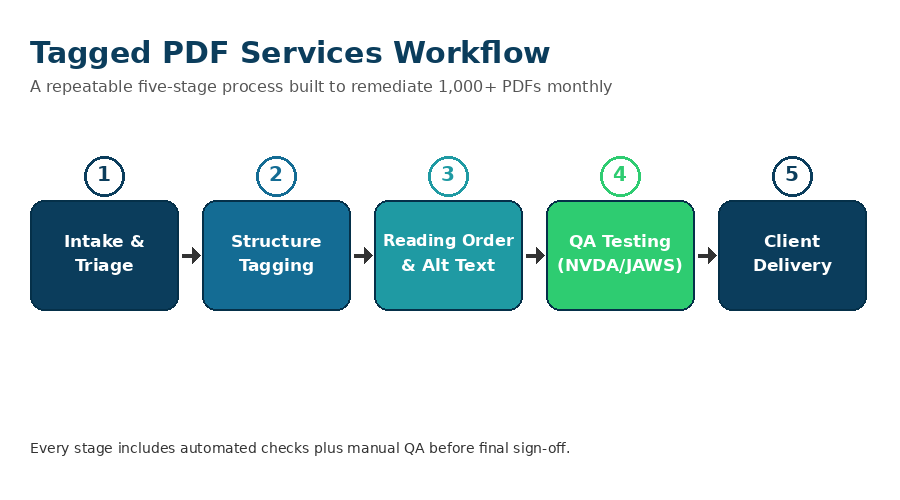
Delivering tagged PDF services at this scale requires a workflow that can repeat itself, file after file, without drifting in quality. We break every project into five clear stages.
Step 1: Intake and Document Triage
Every batch is logged, sorted by complexity, and assigned to the right specialist. Simple text-based documents move through an accelerated path. Complex files with tables, forms, or scanned images are flagged for additional manual attention before tagging begins.
Step 2: Structural Tagging and Reading Order
This is the core of our PDF tagging services. Specialists build a clean tag tree, define correct heading hierarchy, and set logical reading order so content flows properly for screen reader users. Tables receive header associations, lists are marked correctly, and multi-column layouts are restructured for linear reading.
Step 3: Alt Text and Metadata
Every meaningful image receives descriptive alt text, decorative images are marked as artifacts, and document metadata, including title and language, is set correctly. This single step prevents many of the failures we see in documents remediated by less experienced teams.
Step 4: Quality Assurance with Assistive Technology
Before any file leaves our pipeline, it is tested with screen readers such as NVDA and JAWS, checked against automated tools, and reviewed manually by a second specialist. This dual-layer QA process allows us to scale without sacrificing quality, because errors are caught before delivery, not after.
Step 5: Client Delivery and Reporting
Each remediated file ships with a compliance summary showing exactly what was fixed and how it maps to WCAG success criteria. Clients get full visibility into their remediation results, which builds trust and supports internal audit requirements.
How We Protect Quality While Scaling Tagged PDF Services
Volume and quality usually pull in opposite directions. We close that gap in three ways.
First, we standardize templates for recurring document types, such as syllabi or financial statements, so tagging patterns stay consistent across thousands of files. Second, we invest heavily in specialist training. Every team member working on our document accessibility services is certified in accessibility standards and retested regularly.
Third, automation is used only for repetitive detection tasks, never for final sign-off. A trained human always reviews the finished document before it ships. This balance is why our remediation error rate stays below industry benchmarks even as monthly volume climbs past 1,000 files.
According to the Web Accessibility Initiative, correct document structure is one of the most impactful accessibility improvements an organization can make, and that principle guides every decision in our workflow. The Section 508 program also outlines specific technical requirements that our team references throughout every remediation cycle.
Tools and Standards Behind Our Tagged PDF Services
Our PDF remediation services rely on industry-standard tools, including Adobe Acrobat Pro’s accessibility checker, PAC (PDF Accessibility Checker), and CommonLook, alongside internal scripts that flag missing tags automatically. Every file is validated against WCAG 2.1 AA, Section 508, and PDF/UA standards before it is marked complete.
This layered toolset lets specialists focus their time on judgment calls, such as reading order and alt text quality, rather than repetitive manual checks. It also gives project managers a clear, measurable way to track quality across an entire month’s output, rather than relying on spot checks alone.
Frequently Asked Questions
How fast can tagged PDF services be delivered at volume?
Turnaround depends on document complexity, but standardized templates and parallel review teams let us process large batches without extending typical delivery windows.
Do automated tools replace manual review?
No. Automation flags likely issues, but every document in our tagged PDF services pipeline receives manual review and assistive technology testing before delivery.
What file types can be remediated alongside PDFs?
Beyond PDFs, our specialists also remediate Word documents, PowerPoint decks, and scanned files that require OCR before tagging can begin, so your entire document library stays compliant.
Why Choose Rapson Technologies for Tagged PDF Services
Organizations choose our tagged PDF services because we combine speed with accountability. We do not treat accessibility as a checkbox; we treat it as a measurable outcome tied to real user experience. If your team is struggling to keep up with document accessibility demands, our digital accessibility services team can help you build a remediation pipeline that scales without compromising compliance.
Whether you need a single batch remediated or an ongoing monthly partnership, our tagged PDF services are built to handle enterprise volume while protecting the quality your users and auditors expect. Reach out today to discuss your document accessibility goals and see how a proven, scalable process can transform your compliance program.
Tagged PDF Services
Talk to Rapson Technologies’ accessibility experts today.
