Cloud migration cost 2026 planning looks very different than it did even two years ago. Compute pricing has shifted, data egress fees are under more scrutiny, and mid-market companies are moving heavier, more complex workloads than ever before. If you are budgeting for a cloud move this year, understanding realistic numbers, not just a vendor’s opening quote, is the first step toward a project that stays on track.
This guide breaks down cloud migration pricing by category, compares the cost to migrate to AWS/Azure, exposes the hidden costs of cloud migration that catch finance teams off guard, and hands you a practical cloud migration budget template you can adapt this quarter.
What Drives Cloud Migration Cost in 2026
Several factors shape migration spending for mid-market organizations this year. Workload complexity is the biggest driver: a simple lift-and-shift of a handful of servers costs far less than refactoring a legacy application into cloud-native microservices.
Data volume matters too. Companies with large databases or media libraries face higher storage and transfer charges. Compliance requirements, such as healthcare or financial regulations, add another layer of engineering and audit work.
Team readiness plays a role as well. In-house skill gaps push many mid-market teams toward managed service providers, which raises the labor line of the budget but often shortens the overall timeline and reduces costly rework later.
Cloud Migration Pricing Breakdown by Category
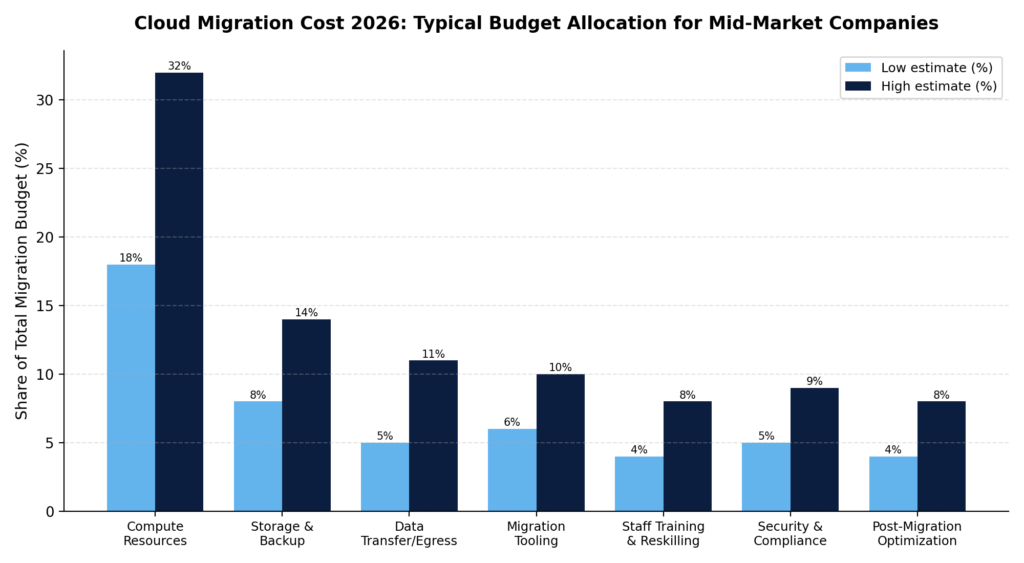
A realistic cloud migration pricing model has five recurring buckets: compute, storage, data transfer, tooling, and people. Most mid-market projects spend the largest share on compute resources, since right-sizing instances takes time and careful testing.
Storage and backup typically run 8 to 14 percent of the total budget. Data transfer, or egress, is smaller as a percentage but frequently surprises teams because it is billed continuously, not as a one-time fee.
Migration tooling, including automated discovery and workload assessment platforms, usually accounts for 6 to 10 percent. Staff training and reskilling close out the list, and this line is often underfunded despite being essential to a smooth transition and long-term adoption.
Cost to Migrate to AWS/Azure: A Side-by-Side View
The cost to migrate to AWS/Azure depends heavily on instance types, reserved capacity discounts, and region selection. For a mid-market company with roughly 50 to 150 servers, total project costs generally fall between $150,000 and $750,000, covering planning, execution, and the first three months of optimization.
AWS tends to offer deeper reserved-instance discounts for steady workloads, while Azure often has an edge for organizations already running Microsoft licensing agreements, thanks to hybrid benefit pricing. Neither platform is universally cheaper; the right choice depends on your existing stack and usage patterns.
Before committing, run both providers’ official pricing calculators, such as the AWS Pricing Calculator, against your actual workload inventory rather than relying on published list prices alone.
Hidden Costs of Cloud Migration Most Budgets Miss
The hidden costs of cloud migration are the single biggest reason projects overshoot their budgets. Data egress fees, idle resources left running after migration, and duplicate licensing during the transition period are the most common culprits.
Security tooling upgrades, accessibility and compliance testing for customer-facing applications, and extended vendor support contracts also add up quickly. Many teams also underestimate the internal hours spent on testing and change management.
A thorough audit, like the assessments offered through Rapson Technologies’ cloud migration management services, helps mid-market companies catch compliance gaps before migration rather than paying to fix them afterward. Addressing accessibility early also protects your brand and reduces legal exposure.
Calculating Cloud Migration ROI
Cloud migration ROI is not just about lower infrastructure bills. It should account for reduced downtime, faster deployment cycles, improved scalability during demand spikes, and freed-up engineering time that can go toward product work instead of hardware maintenance.
A simple formula works well for most mid-market teams: subtract total migration spend and ongoing cloud costs from the combined value of infrastructure savings, productivity gains, and avoided downtime, then divide by the total investment. Most well-planned projects reach positive cloud migration ROI within 12 to 18 months, according to industry benchmarks from Gartner.
Building Your Cloud Migration Budget Template
A solid cloud migration budget template separates one-time costs from recurring ones. One-time costs include assessment, tooling licenses, data transfer, and staff training. Recurring costs include compute, storage, monitoring, and support.
Add a contingency line of at least 15 to 20 percent. This buffer absorbs the hidden costs of cloud migration mentioned earlier and gives your finance team a realistic, defensible number to present to leadership.
Track spend monthly against the template for the first six months post-migration, since usage patterns and costs typically stabilize after that window. Revisit the template quarterly so it keeps reflecting real usage instead of initial assumptions.
Realistic Cloud Migration Cost 2026 Ranges for Mid-Market Companies
Based on current market data, cloud migration cost 2026 for mid-market companies generally falls into three tiers. Small-scope migrations, under 50 workloads, average $75,000 to $200,000. Mid-scope migrations, 50 to 150 workloads, average $150,000 to $750,000.
Large or highly regulated migrations, over 150 workloads, often exceed $1 million once compliance, security, and extended support are included. These figures are directional; your actual total will depend heavily on workload complexity and provider selection.
How to Control Cloud Migration Cost Without Cutting Corners
Start with a workload assessment before requesting vendor quotes. This single step prevents most budget overruns. Negotiate reserved-capacity pricing early, and consolidate tooling licenses wherever possible.
Involve your finance and compliance teams from day one, not after contracts are signed. Early involvement keeps spending realistic and avoids costly rework down the line.
Quick FAQ on Cloud Migration Cost 2026
How long does a mid-market cloud migration take? Most projects run six to twelve months, depending on workload count and complexity.
What is the biggest budget mistake companies make? In most cases, underestimating data transfer fees and staff training time tops the list almost every year.
Ready to Plan Your Cloud Migration Budget
Mid-market companies that plan carefully turn this spending from a source of anxiety into a manageable, well-understood investment. If your team needs a tailored cost estimate, workload assessment, or compliance review, Rapson Technologies can help you build a realistic roadmap and budget suited to your environment. Reach out today to start a conversation about your cloud migration project.
Ready to Plan Your Cloud Migration Budget? ?
Talk to Rapson Technologies’ cloud experts today.
